
Sweet 1.4: stop discounting to earn more margin
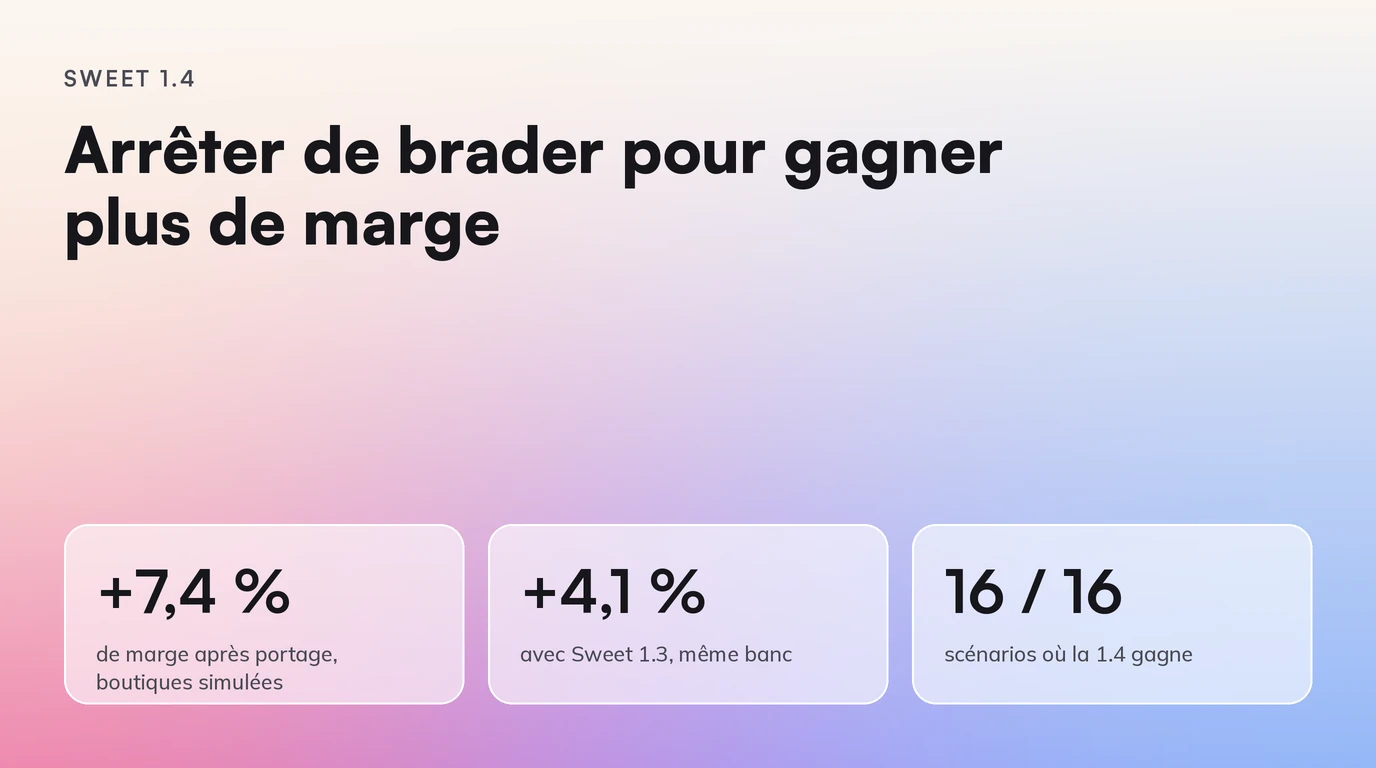
Sweet 1.4 only suggests a promotion if it earns more than full price. On four simulated verticals, the margin gained goes from +4.1% to +7.4%.
Sweet 1.4 discounts less and earns more. On four verticals simulated over 26 weeks, the margin gained on the retailer's usual routine goes on average from +4.1% with Sweet 1.3 to +7.4% with Sweet 1.4.
The change comes down to one rule: a promotion or markdown is only suggested if it earns more than waiting at full price.
What Sweet 1.3 got wrong
Sweet 1.3 already made money, mostly by avoiding stock-outs. But it lost part of it by cutting prices too often.
- A promotion was judged on the revenue it brought in, not on the margin it cost.
- An item with no sale in 60 days was treated as dead and marked down by 50%, sometimes below its purchase price.
- Yet those items were still selling one to five pieces a month: they were slow, not dead.
Result: 1.3 to 2.2 points of gross margin lost on the retailer's routine.
What changes with Sweet 1.4
- Every discount is weighed against waiting. Sweet compares a 10, 20 or 30% promotion with keeping the full price, and only suggests it if it wins.
- Never below the purchase price outside the sales.
- Slow items are no longer liquidated at 50% off. They stay on the shelf, at full price.
- The freed-up recommendations go to restocking, transfers between shops and highlighting, with no discount.
In sport, outdoor and furniture, Sweet 1.4 no longer touches any price over the measured period. In fashion, it keeps a few discounts on large surpluses.
The results
Margin gained on the retailer's routine, over 26 weeks, after deducting carrying cost:
| Vertical | Sweet 1.3 | Sweet 1.4 |
|---|---|---|
| Sport | +€15k (+1.0%) | +€69k (+4.7%) |
| Outdoor | +€66k (+3.8%) | +€135k (+7.6%) |
| Furniture | +€227k (+8.1%) | +€324k (+11.6%) |
| Fashion | +€51k (+3.5%) | +€84k (+5.8%) |
| Average | +4.1% | +7.4% |
- The margin rate returns to the level of the routine: from −0.08 to −0.63 points, against −1.3 to −2.2 points with Sweet 1.3. The gain in euros comes from extra sales, not from slashed prices.
- Fewer stock-outs: the share of demand lost for lack of stock falls to 14.2% instead of 17.9% in sport, 19.3% instead of 24.6% in outdoor, 3.7% instead of 9.1% in furniture, 15.6% instead of 21.2% in fashion.
- Sweet 1.4 beats Sweet 1.3 in all 16 cases tested, in points and in euros: four verticals, two draws of sales, three price sensitivities.
The downside: a little more dead stock
Not discounting means keeping on the shelf items that Sweet 1.3 would have put on sale. In outdoor, furniture and fashion, stock with no sale in 60 days rises compared with Sweet 1.3: from €68k to €94k in furniture, for example.
It stays well below that of the retailer's routine in all four verticals, and its carrying cost is already deducted from the figures above.
How we measured
- Four simulated shops, one per vertical (sport, outdoor, furniture, fashion), built from the public catalogues of 15 retailers: real items, real prices.
- 26 weeks replayed, from March to August 2026, with the same sales for each version.
- The reference is the retailer's routine: one review a week, restocking based on the last 60 days of sales. Sweet is added on top, with 10 recommendations applied per day.
- The sales affect the whole range, on the same dates, whatever the version.
- The margin is gross margin in euros, minus a carrying cost of 25% a year of the stock value.
The limits, which you should know about:
- The margins of each vertical are statistical estimates, not a retailer's accounts.
- Customers react to price with a fixed sensitivity (elasticity 1.8). We checked 1.2 and 2.5: the ranking does not change.
- An unsold item does not lose value in the simulator, which favours the choice not to mark down. Sweet nevertheless counts a write-down for unsold items in its calculations, hence the few remaining discounts in fashion.
- Transfers between shops have no cost.
These are simulated shops. The real gain is confirmed on your own data.
What it changes for you
- Fewer discounts suggested, and each one justified by what it earns compared with waiting.
- More restocking at the right time on the items that sell.
- Your slow items are no longer sacrificed: Sweet favours highlighting them or transferring them to another shop.
To put a figure on what this means for your shop, the gains calculator starts from your revenue and your margin.
Frequently asked questions
Does Sweet 1.4 never run promotions any more?
It does, when a promotion earns more than waiting at full price: a large end-of-season surplus, for example. It no longer suggests one by reflex.
Why doesn't the margin rate rise above the routine?
Because Sweet sells more, including during the sales, when the whole range is marked down. The rate stays stable, but the margin in euros increases.
Do these figures apply to my shop?
They are orders of magnitude measured on simulated shops. In a demo, we redo the calculation on your sales history.