
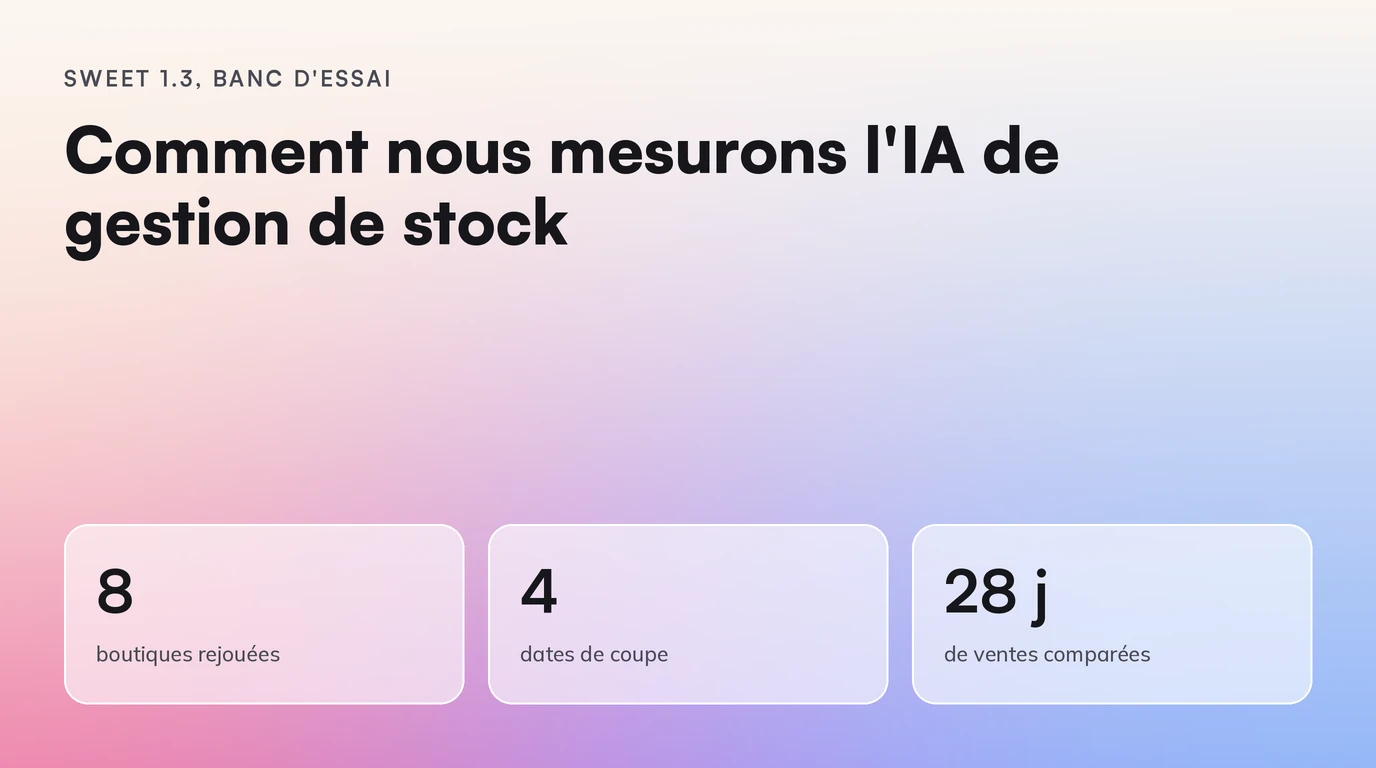
How we measure Sweet 1.3, the AI inventory management of Sway One
Before shipping Sweet 1.3, we replayed eight shops over a year of sales: forecasts, stock-outs, stock cost and decisions, measured before and after.
An AI for inventory management should be judged on sales it has never seen. To ship Sweet 1.3, we built a benchmark that replays the past and compares every forecast and every decision with what actually sold afterwards.
The benchmark at a glance
| Step | What we do |
|---|---|
| 1. Shops | 8 demo shops, more than 23,000 products, one year of sales |
| 2. Cut-off | 4 dates, from May to August: the model only sees the past |
| 3. Forecast | Compared with the following 28 days: range, error, coverage |
| 4. Restock | Simulated at 90% service level: stock-outs, lost margin, stock cost |
| 5. Decisions | Every discarded action is re-judged on its actual gain |
The shops cover menswear and womenswear, outdoor, running, saddlery, tennis and padel, a children's brand and a textile brand. Their catalogues come from real shops; their sales are simulated, identical on every run, so two versions can be compared on equal terms.
From Sweet 1.1 to Sweet 1.3
Sweet is the family of AIs that powers Sway One: Echo for the daily briefing, Flow for continuous production, Horizon for stock forecasting, Orbit for the full analysis and Reserve for pre-orders.
Sweet 1.3 adds three nodes to them:
- Horizon, which pits the statistical model against a day-by-day forecast, product by product;
- Sweet Instinct, which arbitrates between these forecasts and rescues the good actions that the filters had discarded;
- a sourced news recap for the sector, to test hypotheses about demand.
Each shop has its own settings, in its configuration.
The results are in two articles: Horizon, product-by-product stock forecasting and Sweet Instinct.
Frequently asked questions
Why demo shops?
To compare two versions, you need to replay exactly the same sales, without touching a customer's data. For your shop, we repeat the measurement on your own history.
What do you measure first?
The real cost to the retailer: sales lost to stock-outs and money tied up in stock. A more accurate forecast is only worth something if it improves those two figures.